Two-Way ANOVA With and Without Replication: Complete Guide
Two-way ANOVA (Analysis of Variance) is a statistical method used to examine the effects of two categorical independent variables, known as factors, on a continuous response variable.
Unlike one-way ANOVA, which evaluates the effect of a single factor, two-way ANOVA allows researchers to investigate two main effects and, when replication is available, the interaction between them.
Two-way ANOVA is widely used in agriculture, biology, healthcare, manufacturing, marketing, social sciences, and experimental research.
What Is Two-Way ANOVA?
Suppose a researcher wants to determine whether two factors affect plant growth:
- Factor A: Sunlight exposure
- Factor B: Watering frequency
- Response: Plant growth in inches
A two-way ANOVA can answer three important questions:
- Does sunlight exposure significantly affect plant growth?
- Does watering frequency significantly affect plant growth?
- Does the effect of sunlight depend on watering frequency?
The third question is the interaction effect.
A two-way ANOVA model with replication can be represented as: Yijk=μ+αi+βj+(αβ)ij+ϵijk
where:
- Yijk = observed response
- μ = overall mean
- αi = effect of factor A
- βj = effect of factor B
- (αβ)ij = interaction effect
- ϵijk = random error
Two Types of Two-Way ANOVA
Two-way ANOVA is commonly encountered in two forms:
Two-Way ANOVA Without Replication
There is only one observation for each combination of factor levels.
For example, if sunlight has four levels and watering has two levels, there are: 4×2=8
observations in total.
Two-Way ANOVA With Replication
There are multiple observations for every combination of factor levels.
For example, if five plants are measured for every sunlight × watering combination: 4×2×5=40
observations are available.
The distinction is important because replication provides an estimate of experimental error within each factor combination and allows the interaction effect to be tested separately.
Example: Sunlight and Watering Frequency
Imagine a botanist wants to study how sunlight and watering frequency affect plant growth.
Factor A: Sunlight
- None
- Low
- Medium
- High
Factor B: Watering
- Daily
- Weekly
Response Variable
Plant growth in inches.
The experimental structure looks like this:
| Sunlight | Daily | Weekly |
|---|---|---|
| None | 4.8 | 4.4 |
| Low | 5.0 | 4.9 |
| Medium | 6.2 | 5.7 |
| High | 7.1 | 6.3 |
This represents two-way ANOVA without replication, because there is only one measurement for each combination.
Two-Way ANOVA Without Replication
In a no-replication design, each factor combination has only one observation.
For example:
| Sunlight | Daily | Weekly |
|---|---|---|
| None | 4.8 | 4.4 |
| Low | 5.0 | 4.9 |
| Medium | 6.2 | 5.7 |
| High | 7.1 | 6.3 |
The analysis can evaluate whether the row factor and column factor have significant effects.
However, there is an important limitation:
A standard two-way ANOVA without replication cannot separately estimate and test the interaction between the two factors.
The interaction variation is effectively absorbed into the error term under the usual additive model.
Therefore, if interaction is scientifically important, replication is strongly preferred.
Two-Way ANOVA With Replication
With replication, multiple observations are collected for every factor combination.
For example, suppose five plants are used for each combination of sunlight and watering.
A simplified dataset might look like:
| Sunlight | Watering | Growth |
|---|---|---|
| None | Daily | 4.8 |
| None | Daily | 4.4 |
| None | Daily | 3.2 |
| None | Daily | 4.6 |
| None | Daily | 4.1 |
| None | Weekly | 4.4 |
| None | Weekly | 4.1 |
| None | Weekly | 3.9 |
| … | … | … |
Now the researcher can estimate:
- Sunlight main effect
- Watering main effect
- Sunlight × watering interaction
This makes the replicated design much more informative when interaction is part of the research question.
What Is an Interaction Effect?
An interaction occurs when the effect of one factor depends on the level of another factor.
For example, suppose increasing sunlight produces a large increase in plant growth when plants are watered daily but produces only a small increase when plants are watered weekly.
In that situation, sunlight does not have the same effect under both watering conditions.
That is an interaction between sunlight and watering.
A useful way to visualize this is with an interaction plot.
If the lines are approximately parallel, there may be little interaction.
If the lines diverge substantially or cross, this may indicate an interaction.
Why Interaction Matters
Consider the following hypothetical results:
| Sunlight | Daily Watering | Weekly Watering |
|---|---|---|
| None | 4.0 | 3.9 |
| Low | 5.0 | 4.2 |
| Medium | 6.5 | 4.5 |
| High | 8.0 | 4.7 |
The effect of increasing sunlight is much stronger with daily watering.
Therefore, simply reporting the main effect of sunlight could hide an important feature of the data.
When an interaction is significant, researchers should generally interpret the main effects in the context of that interaction, rather than treating the main effects as completely independent.
Hypotheses in Two-Way ANOVA
For factor A: H0:There is no main effect of Factor A HA:There is a main effect of Factor A
For factor B: H0:There is no main effect of Factor B HA:There is a main effect of Factor B
For the interaction: H0:There is no interaction between A and B HA:There is an interaction between A and B
Each hypothesis produces its own F-statistic and p-value in a replicated two-way ANOVA.
Two-Way ANOVA in Excel
Microsoft Excel provides two relevant options through the Data Analysis ToolPak:
- ANOVA: Two-Factor Without Replication
- ANOVA: Two-Factor With Replication
Without Replication
Use this option when there is one observation for each combination of factor levels.
The output typically includes tests for:
- Rows
- Columns
- Error
There is no separate interaction test.
With Replication
Use this option when there are multiple observations for each combination.
The output includes:
- Sample
- Columns
- Interaction
- Within
- Total
The Interaction row is particularly important because it allows you to assess whether the effect of one factor depends on the other.
Interpreting the P-Values
Suppose a replicated two-way ANOVA produces:
| Source | P-value |
|---|---|
| Sunlight | 0.002 |
| Watering | 0.081 |
| Sunlight × Watering | 0.315 |
Using α=0.05:
Sunlight
p=0.002<0.05
There is evidence that sunlight exposure affects plant growth.
Watering
p=0.081>0.05
There is insufficient evidence of a main effect of watering frequency.
Interaction
p=0.315>0.05
There is insufficient evidence that the effect of sunlight depends on watering frequency.
Therefore, the researcher could conclude that sunlight has a statistically significant effect, while watering and the sunlight × watering interaction were not statistically significant at the 5% level.
Important Assumptions
Two-way ANOVA relies on several important assumptions.
1. Independence
Observations should be independent.
This is primarily a property of the experimental design and data collection process rather than something that can be fixed after the data have been collected.
2. Continuous Response Variable
The response variable should generally be continuous and reasonably suitable for an ANOVA model.
3. Approximately Normal Residuals
The residuals should be approximately normally distributed.
Q-Q plots and residual diagnostics are often more informative than relying solely on a formal normality test.
4. Homogeneity of Variance
The residual variance should be reasonably similar across groups or factor combinations.
Levene’s test or other variance diagnostics can be used when appropriate.
With Replication vs Without Replication
| Feature | Without Replication | With Replication |
|---|---|---|
| Multiple observations per cell | No | Yes |
| Main effect of Factor A | Yes | Yes |
| Main effect of Factor B | Yes | Yes |
| Separate interaction test | No | Yes |
| Estimate within-cell error | Limited | Yes |
| Statistical information | Lower | Higher |
| Preferred when interaction matters | No | Yes |
Which Approach Should You Use?
The choice should be based on the experimental design.
Use Two-Way ANOVA Without Replication When:
- There is only one observation per factor combination.
- Replication is not available.
- The research question focuses on additive main effects.
- Interaction cannot reasonably be estimated separately.
Use Two-Way ANOVA With Replication When:
- Multiple observations are available for each factor combination.
- Interaction is scientifically important.
- You want a separate estimate of within-group error.
- The experiment has been designed to support interaction analysis.
Whenever feasible, replication is generally preferable, particularly when interaction effects are important.
A Practical Decision Framework
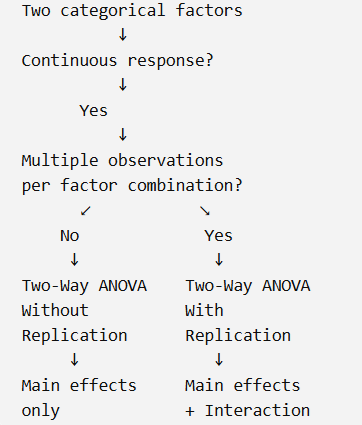
Common Mistakes
Mistake 1: Treating Replication as Repeated Measurements
Multiple measurements from the same experimental unit are not automatically independent replicates.
For example, measuring the same plant five times does not necessarily provide five independent experimental units.
True replication usually refers to independent experimental units receiving the relevant treatment combination.
Mistake 2: Ignoring Interaction
When replication is available, researchers should consider the interaction term rather than examining only the two main effects.
Mistake 3: Interpreting Main Effects Without Considering Interaction
If the interaction is substantial, the effect of one factor may differ across levels of the other factor.
In such cases, interaction plots and simple-effects comparisons can provide a more meaningful interpretation.
Mistake 4: Assuming a Non-Significant Interaction Proves No Interaction
A non-significant p-value means there is insufficient statistical evidence for an interaction under the specified model. It does not prove that the interaction is exactly zero.
Confidence intervals and effect sizes can provide additional information.
Conclusion
Two-way ANOVA provides a powerful framework for studying the effects of two categorical factors on a continuous outcome.
The key distinction between the two designs is replication.
Two-way ANOVA without replication has one observation for each factor combination and can evaluate the main effects, but it cannot separately estimate the interaction effect under the standard model.
Two-way ANOVA with replication contains multiple observations for each factor combination and allows researchers to evaluate both main effects and the interaction between the factors.
When interaction is scientifically important, a replicated experimental design is generally the better choice.
Before conducting the analysis, researchers should also evaluate independence, residual normality, variance homogeneity, experimental design, and the nature of the response variable.
Used appropriately, two-way ANOVA can provide much richer insight than analyzing each factor separately because it allows researchers to understand not only whether each factor matters, but also whether the effect of one factor changes depending on the other.
Related: Statistical Analysis » Statistics Methods » Quick Guide » FINNSTATS